
Chemical scrubbing
AmerAir International stands at the forefront of delivering comprehensive odor control solutions in the Middle East, harnessing proven chemical scrubbing, biological filtration, and cutting-edge carbon adsorption technologies. Our expertise extends beyond technology, encompassing strategic partnerships with premier suppliers for essential peripherals like pumps and fans, integral to our meticulously designed systems.
Efficient Chemical Scrubbing Odor Control
In chemical scrubbing systems, polluted air is drawn in using fans and directed through chemical scrubbers for thorough treatment. This process involves the air passing through a packed media, which interacts with a scrubbing solution containing chemical reagents. Through dissolution and reaction, the polluted gases are effectively neutralized. The result is clean air that’s discharged through a stack positioned on top of the scrubber.
For situations where multiple pollutants are present, a wet scrubber system is employed. This allows the use of different chemical agents in each stage, targeting specific gaseous contaminants. Our scrubbers are capable of efficiently removing a wide range of inorganic and organic gases, with a proven track record in meeting stringent standards for gases like SO2, NO, NO2, HCl, Cl2, HBr, Br2, Ethanol, and MEK.
These chemical scrubbing systems offer a remarkable removal efficiency that can reach up to 99.99% or even higher when needed, making them highly effective in eliminating odor-causing agents. The system’s recirculation pump ensures the efficient use of scrubbing liquid, and a water softener can be integrated for makeup water. The chemical dosing system, complete with storage tanks and dosing pumps, forms the backbone of the operation.

AAI's Expert Chemical Scrubbing Technique
Wet scrubbers have long been relied upon for air pollution control, efficiently removing pollutants from air streams containing gases, liquids, or solid particulates. Chemical scrubbing, specifically designed for gas-liquid interactions, effectively eliminates pollutants through mass transfer processes. Careful equipment selection is essential, considering factors such as mass transfer units, pressure drop, efficiency requirements, and operational reliability.
AAI’s scrubber designs account for packing depth, ensuring desired collection efficiency. The housing design prioritizes durability, corrosion resistance, and easy maintenance. Constructed from GRP, it combines low weight and cost-effectiveness. The K-Rosette filamentous packing, which removes particulates through inertial impaction, boasts a square cross-section for enhanced efficiency and reduced pressure drop. The packing material’s 10-year warranty and expected 20-year lifespan underscore its reliability and long-term performance.
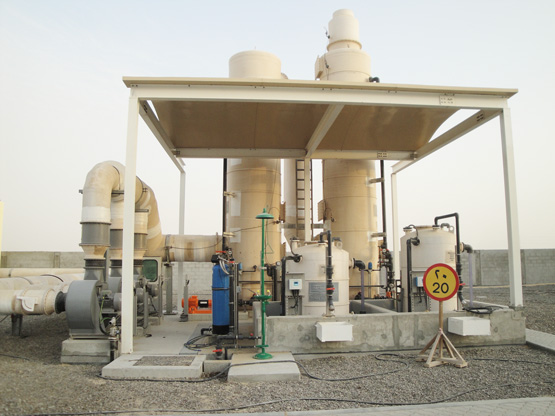
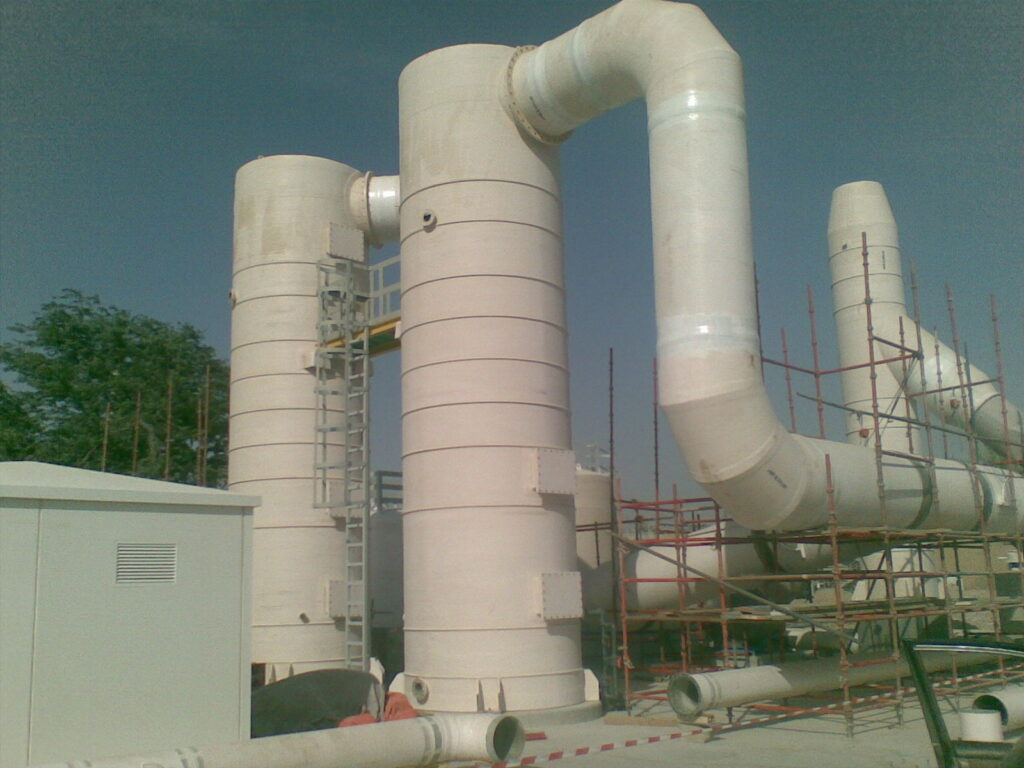
For gaseous pollutant control, packed tower wet scrubbers are the most common purification systems. These wet scrubbers increase the efficiency of gaseous pollutant treatment by increasing the area and contact time and sufficient mixing of the gaseous pollutant with the scrubber liquid.
In packed tower wet scrubbers, the scrubber liquid is sprayed onto the packed bed materials between the support plates and a thin layer of scrubber liquid is constantly created on the bed. To contact the contaminated air flow passing through the bed. The gaseous pollutant in the passing air flow reacts with it upon contact with the scrubber liquid and is separated from the air flow.
This device can be used to remove gas from the scrubber tower for gas absorption. However, they are not as efficient as packed or plate towers. Spray towers can be very effective in removing pollutants if the pollutants are soluble or if a chemical reagent is added to the liquid.
For example, a gas scrubber tower is used to remove HCl gas from the tail gas exhaust in the production of hydrochloric acid. In the production of superphosphate used in fertilizer production, SiF4 and HF gases are discharged from various points in the process. Scrubber towers have been used to remove these highly soluble compounds.
Gas scrubbers are used to remove odors in the bone meal and tallow industries by treating the exhaust gases with a KMnO4 solution. They are highly capable of controlling large volumes of gas in corrosive atmospheres. They are also used in the design and construction of scrubbers in a number of flue gas desulfurization systems as the first or second stage in the pollutant removal process.
In a scrubber tower, absorption can be increased by reducing the size of the liquid droplets or increasing the liquid to gas ratio (L/G). To achieve either of these, an increase in both power consumption and operating cost is required. In addition, the physical size of the tower limits the amount of liquid and the droplet size that can be used.
In this type of scrubber, due to the presence of the bed, it is not possible to simultaneously purify particles and gas, because the particles settle inside the bed and block the air flow inside the bed.
How the Absorption Tower Works
One way to separate the components of a gas mixture that is in proximity to a solvent (liquid phase) is called the absorption process. The basis of this process is the difference in solubility of the components in the gas phase. As a result of the contact of the gas phase with the liquid, one or more components of the gas phase go to the liquid phase and are separated from it. The dissolved component is separated in the solvent in a distillation tower or by using pressure reduction in another tower. In this way, the solvent can be reused, which makes the process more economical and justifiable. Due to the transfer of components from the gas and liquid phases, which requires high pressure during operation, this process is carried out at high pressure. The absorption process is a process in which a gas mixture is placed in contact with a liquid (solvent) so that one or more components of the gas mixture dissolve in the liquid. The absorption process is used in industry to prepare solutions (such as absorbing chlorine by distilled water and preparing hydrochloric acid solutions), remove undesirable compounds (such as removing carbon dioxide from natural gas or synthesis gas by solutions of alkali salts or amines), or separate compounds with high economic value (such as separating anhydrite gas in a soda factory and separating ammonia in a refinery). This process is carried out in two ways: absorption with a physical solvent and absorption with a chemical solvent.
Gas scrubber
Gas scrubbers are cleaning installations in which a gas stream is brought into intensive contact with a fluid, the aim of which is to remove gaseous components from the gas to the liquid. Gas scrubbers can be used as an emission control technique in the emission of various gases. Gas scrubbing is also called absorption. In gas scrubbers, therefore, we speak of the transfer of components from the gas phase to the liquid phase. The extent to which the gaseous components can be converted to the liquid phase depends on the solubility of these components in the fluid.
The equilibrium concentration in the dust phase, which corresponds to a certain concentration in the fluid phase, depends on the temperature; a higher temperature of the fluid phase leads to a higher equilibrium concentration in the dust phase. Therefore, a decrease in temperature also has a favorable effect on the output. By adding chemicals to the carrier fluid in which the adsorbed components are converted, the load can be increased. Adding chemicals that can react with the adsorbed gases has a favorable effect on the absorption output.
In addition to water (wet scrubbers), organic liquids are also used as absorbent fluids. In many cases, chemicals or microorganisms are added to the absorbent fluid to neutralize or neutralize the gases dissolved in the fluid (air scrubber). With this conversion, the concentration in the water becomes lower and more gases can be dissolved (according to Henry’s law).
In practice, a gas scrubber consists of three components:
- An absorption section for material exchange
- A circulation tank
- Pump
The liquid gas ratio (L/G) in a gas scrubber is the ratio between the flow of the carrier fluid and the circulation of the gas flow. In terms of dimensions and for evaluating the performance of a gas scrubber, it is important to know how much fluid per cubic meter of gas is required to achieve the desired residual emission.
The L/G ratio is determined not only by the required residual emission, but also by the concentration of the mobile components in the gas stream and the inlet and outlet liquid streams. The L/G ratio in a concrete situation therefore depends on the selected carrier system, the properties of the scrubbing gas, the absorbent fluid and the mobile component and the requirements for residual emission.
Gas scrubbers can be classified based on the direction of gas flow relative to the fluid. Hence, they are distinguished in counter-current scrubbers or cross-flow scrubbers. The applications of different types of scrubbers, especially gas scrubbers for purification, are given below. The advantages of gas scrubbers are:
- Wide range of applications
- Very high output rejection
- Compact installation and ease of maintenance
- Relatively simple technology
- Can also be used as a cooler for hot gas streams (quencher)
The disadvantages of gas scrubbers include:
- Wastewater must be treated
- Water and reagent consumption
- Dehumidification is required when dust is simultaneously removed
- Sensitive to cold
- May be necessary depending on construction site
What happens to the contaminants removed by the scrubber?
Wet scrubbers trap airborne particles by direct contact with a spray of water or other liquids. In effect, a scrubber washes particles from a dirty air stream as they collide with the countless tiny droplets in the spray.
What chemicals are used in scrubbers?
Chemical scrubbers (often called gas scrubbers) are specifically designed to remove one or more types of gaseous pollutants depending on the customer’s needs. Often these pollutants are chemicals such as ammonia, chlorine or sulfur compounds. (Inside the absorbent fluid)
Components of a chemical scrubber
- Spray tower in scrubber
A spray tower (or spray column or spray chamber) is a gas-liquid contactor, essentially a scrubber tower. It is used to achieve mass and heat transfer between a continuous gas phase (which may contain dispersed solid particles) and a dispersed liquid phase. It consists of a hollow cylindrical vessel made of steel or plastic and nozzles that spray the liquid into the vessel. The inlet gas stream usually enters at the bottom of the tower and travels upward, while the liquid is sprayed downward from one or more surfaces. This flow of inlet gas and liquid in the opposite direction is called countercurrent flow. This type of technology can be used, for example, as a wet scrubber for air pollution control. Countercurrent flow exposes the outlet gas with the lowest pollutant concentration to the freshest scrubbing liquid.
How do spray towers work?
It consists of an empty cylindrical vessel made of steel, plastic or GRP and nozzles that spray the liquid into the vessel. The inlet gas stream usually enters at the bottom of the tower and travels upwards, while the liquid is sprayed downwards from one or more levels.
- Exhaust Fan
The main purpose of an exhaust fan is to remove moisture, heat, contaminants, and stale air from an enclosed space. These fans also help control and eliminate odors. In addition, they add to the safety of the environment by reducing fumes from cleaning agents, which can potentially cause health problems. Wet scrubbers use water and various reagents in the form of a mist to remove hazardous gases or particles from the air stream. The function of the centrifugal industrial fan in a scrubber system is to transport and suck contaminated air from the source and pass it through the scrubber for purification and discharge.
- Nozzle in spray tower
Many nozzles are placed at different heights on the tower to spray the entire gas as it moves up the tower. The reason for using many nozzles is to maximize the number of fine droplets impacting the pollutant particles and to provide a large surface area for gas absorption. Theoretically, the smaller the droplets formed, the higher the collection efficiency for gaseous and particulate pollutants.
The liquid droplets must be large enough not to be carried away by the scrubber exhaust gas. Therefore, spray towers use nozzles that produce droplets typically 500-1000 micrometers in size. Although their size is small, these droplets are large compared to those produced by venturi scrubbers, which are 10-50 micrometers in size.
The gas velocity is kept low, 0.3 to 1.2 m/s (1-4 ft/s) to prevent excess droplets from being carried out of the tower. To maintain low gas velocities, spray towers must be larger than other scrubbers that use similar gas flow rates. Another problem is that after the droplets fall a short distance, they tend to agglomerate or hit the tower walls. The total liquid surface area for contact is reduced, reducing the scrubber’s collection efficiency.
Generally speaking, a spray nozzle is a precision device that disperses a liquid in a scrubber tower. Nozzles are used for three purposes: distributing liquids over an area, raising the liquid level, and creating an impact force on a solid surface. Spray nozzles can be classified based on the input energy used to create atomization, the breaking up of the liquid into droplets.
Spray nozzles can have one or more outlets. A multiple outlet nozzle is known as a compound nozzle. Sprayers range from heavy industrial use to light spray cans or spray bottles.
- Scrubber tower packings
Scrubber tower packings (packing materials or media) or packing media are pieces, sheets or blocks that are often made of PVC or PP (polypropylene). These equipment are highly resistant to chemicals, acids, fats and oils and biological materials and are produced in two types of fixed packing media and floating (suspended) packing media. The geometric shape of the packing increases the surface area to volume ratio. Packing media has a variety of uses in various industries including water and wastewater, refinery and petrochemical, ventilation, etc.
Amerair International has a license to design and produce a special type of packing that creates the best flow porosity and has the ability to withstand heavy weight.

- Absorbent
Many chemicals can also be removed from exhaust gases by using absorbent materials. Contaminated air enters the scrubber from the bottom and rises. The absorbent material is sprayed onto the packings through a spray nozzle. The packings create inconsistencies in the air flow movement, allowing the air to come into maximum contact with the absorbent material. The absorbent material combines with the air pollution and settles to the bottom of the scrubber.
Usually, the absorbent material is located in separate tanks next to the scrubber and is injected into the scrubber by a dosing pump.
The absorbent material is determined according to the type of air pollution and its amount is determined according to the amount of pollution, the volume of the scrubber and the air flow rate.
- Absorbent material tanks
These tanks are usually located in pairs next to the scrubber and have one or two dosing pumps to inject absorbent materials into the scrubber. The size and volume of these tanks depend on the amount of absorbent materials injected into the scrubber monthly.

What is the return flow in a scrubber tower?
In wet scrubbers, an absorbent fluid must always be used to perform the absorption process from the inlet gas. This absorbent fluid is placed in the form of a basin at the bottom of the scrubber and is constantly flowing through the scrubber through circulation pumps. This return flow to the tower must always be monitored and, if saturated, drained and replaced with new fluid.
Retention phenomenon in the scrubber tower
The gas flow entering the wet scrubber is purified through contact with the absorbent fluid, and the longer the contact time between the gas and the absorbent, the better the absorption process. For this reason, a packing media system is used in scrubbers to increase the gas retention time in the scrubber system. Obviously, the longer the retention time, the greater the scrubber efficiency, but this time must be sufficient to prevent damage to the suction system connected to the scrubber (blower) and the so-called tower from choking.